
MY REEF JOURNEY
My love affair with the ocean didn’t start in a high-tech reef lab or with pristine coral colonies, it started more than 30 years ago with a 3-foot tank, an under-sand filter, and a whole lot of trial and error. Shocking, I know. But back then, I made it work through relentless water changes and constant husbandry. Thankfully, it was only a fish-only system, because the moment I introduced corals… everything died, or got eaten.

That painful (and expensive) lesson forced me to confront a hard truth: I didn’t know what I was doing. So I did what every passionate reef keeper eventually does, I started researching. Properly. Not quick internet searches (this was pre-Google days), but real books, real libraries, and endless note-taking. What I quickly discovered was how full of contradictions reef keeping really is. For every method, there were ten opposing opinions. Even today, with all the information available, you never stop learning. I still learn something new about corals and reef systems almost every single day. As research in the reef world continues, driven by people like Doug Dorrat and Claude at Fauna Marin – we’re still uncovering better practices, improved methodologies, and entirely new ways of thinking. I’ve been incredibly fortunate to receive personal guidance from Doug on a few of my own systems, and he often reminds me: “You’ll never stop learning.” He’s absolutely right.
Back to pre-Doug Dorrat days, armed with be er equipment, a larger tank, and a shelf full of reference books, I thought I had finally cracked it. Then, 9 to 12 months later, everything started dying again. Back to the library I went. More books, more reading, more humility. I realised that I still didn’t know nearly as much as I thought. Around this me, I began connecting with other reef keepers through online forums. Between shared experience, renewed research, and a lot of patience, I finally started keeping things alive… and growing. For many happy years I ran LPS and so coral systems alongside a FOWLR tank, and life was good. Then I was introduced to SPS. That single moment changed my entire reef-keeping world. The colours, the growth forms, the challenge – I was completely hooked. Mistakes were made. Money was wasted. Corals were lost. But I wasn’t giving up. I was obsessed with mastering SPS, and I still am. But I still lose corals, you always will. Even the coral farms face the very same challenges.


It was around this me that I was introduced to Doug Dorrat…
Doug didn’t sell me shortcuts or magic bottles of chemicals. What he gave me was an entire new perspective. He reinforced the idea that reef keeping is not about perfection, but consistency, observation, and the realisation that we don’t grow corals, they’ve managed that for thousands of years without our help, what we do is condition our water column, and If we get that right, and fully understand the complexity of conditioning and maintaining our water, our corals will grow. But that is the challenge we face in a closed system that doesn’t have millions of gallons and more of natural sea water passing through every day. A reef system as we know it in our hobby world, and commercial propagation farms, does not work the same. The corals require elements, some not even detectable in the sea to survive, and this is why we are still learning today. I used to get really upset by coral losses, but he taught me that losses aren’t failures – they are part of the process, part of the learning curve that never truly ends. His words s ll ring in my ears every day I look into a system or spot a frag not doing so well: “You’ll never stop learning.”
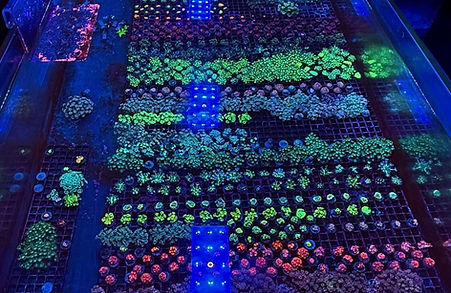
Today, I’m lucky enough to spend my days doing what I love – caring for corals. I now run four display tanks in my home, one of which is around 98% SPS and quite literally bursting at the seams, with our shop full of frag trays growing out SPS colonies and frags. And as if that wasn’t enough, we are currently having a 2,500-litre display tank built and installed, which will mainly house SPS. I ask myself why every single day, but once you enter the world of SPS, there’s no going back.
Be warned. What began as a simple hobby became a lifelong passion – and that passion led me here, to Atlantis Reef Emporium.
Welcome to my world !